When I moved into my first apartment on my own in 2008, I was in a terrible place emotionally. Unhappy with my body and my life, I turned to food, numbing myself with frequent Taco Bell binges, the ever-present stockpile of cheesy snacks in my pantry and calorie-dense cocktails. By July 2011, my weight had ballooned to an unbelievable 318 pounds, and I had grown more miserable than ever. At one point, my stepmom was so concerned that she treated me to a salon day to try to snap me out of my funk. After being pampered for hours, I realized how much I missed taking care of myself. That's when I decided it was finally time to get serious about slimming down.
Bye-bye, fake food Within a month, I joined my local weight-loss center. When I reviewed the first week's meal plan, I was pleasantly surprised: The three meals and two snacks a day offered me more real food for far fewer calories than I was used to. And because there were filling options, like spinach quiche and chicken stir-fry, I never felt hungry. I began to eat clean and almost immediately lost 18 pounds, and the heartburn that had plagued me since my teens disappeared.
Hello, happier me I quickly found my way around the kitchen, and two months later I had knocked off another 32 pounds. My energy level soared: While I had once been a slave to the snooze button, I started waking up at 5:20 each morning, excited to start the day. And I was more active, taking two- to three-mile walks around my neighborhood. Slowly but steadily, the pounds melted away.
By June 2013, almost two years after starting my transformation, I had dropped more than half my weight; I was down to 150 pounds. In the year since, my daily walks have transitioned into runs, and I even completed my first half marathon. There was a time when the notion of running was laughable to me, but after coming so far, I finally feel like my life has no limits.
Her Stay-Slim Tool Kit For Leigh, healthy living is about the details. Find out what keeps her going forward, and score more tested tips on Pinterest.
Sweet Escape: When I crave something a little indulgent, I have a South Beach Diet whipped peanut butter bar—it tastes almost exactly like fudge. At 100 calories, it's a perfect midmorning or afternoon treat.
Magic Kicks: My boyfriend got me Brooks PureConnect 3 running shoes. They're so light, I feel like they give me wings!
Up Running Song: I have "Happy" by Pharrell Williams on my workout playlist. When it comes on around mile six, I feel like I'm in total butt-kicking mode and can't help running down the street clapping, smiling and lip-synching.
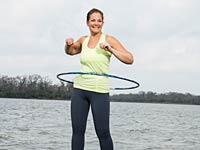
Throwback Toner: Hula-Hooping is a favorite. It's fun and never feels like exercise. I keep one in my yard for when I get the urge to move!
Soap commercials (and all commercials, one could argue) are all about the power of tiny differences, convincing you that some small detail about this product is going to make your face exponentially cleaner than whatever you're currently using. For a while, microbeads were the cool new thing, as evidenced by this face wash commercial where Hayden Panettiere dances around, proclaiming that "Icy blue microbeads exfoliate and clean deep down to pores!"
The microbeads, used in many different soaps, are tiny pieces of plastic that provide grittiness, for extra scrubbing power. And last week, Illinois Governor Pat Quinn signed a bill into law that bans them. Companies will have to stop manufacturing products with microbeads by the end of 2018, and such products can no longer be sold in Illinois starting at the end of 2019.
The controversy around the beads has been building for some time. The problem, opponents say, is that the beads are too micro—they can slip through filtration systems and find their way into waterways, where they sit, gleaming, beckoning fish who think they are tasty treats.
While it's obviously not great, in and of itself, that fish could be eating plastic, what's more worrisome is that the plastics have been shown in tests to absorb pollutants like pesticides and polycyclic aromatic hydrocarbons (created by combusting fuels like wood, diesel, and coal) from the air and water around them.
"Plastic can absorb and concentrate pollutants, and easily transfer them to aquatic organisms," says Dr. Lorena Rios Mendoza, an assistant professor of chemistry at the University of Wisconsin, Superior. "Some of these pollutants are endocrine disruptors," she adds, which means they could affect animals' reproductive cycles. More research is needed on just how the plastic is affecting the fish, and if those effects could potentially travel up the food chain.
Illinois, nestled up to Lake Michigan as it is, has reason to be at the forefront of this movement. Research done by environmental group 5 Gyres, which is dedicated to decreasing plastic pollution, found particularly high levels of microbeads in the Great Lakes—"higher than most oceans worldwide," the press release says. On average, the team found 43,000 particles per square kilometer, or about 107,500 particles per square mile. The highest concentration was found in Lake Erie, where 90 percent of all the plastics found came from. Mendoza, who has been analyzing samples taken by 5 Gyres, says she sees twice the level of pollutants in samples from Lake Erie as in samples from the Atlantic Ocean (while keeping in mind that the ocean is much bigger).
The 5 Gyres Institute shared these results with manufacturers of personal care products who use microbeads, and many of them—Unilever, L'Oreal, Colgate-Palmolive, Johnson & Johnson, The Body Shop, and Procter & Gamble—agreed to phase out the beads from their products. According to a statement from Unilever, the company is on track to be bead-free in the U.S. and Canada by the end of this year, moving instead toward other exfoliants like silica and walnut skin. A statement from Johnson & Johnson says the company will stop using the beads by 2017.
On the regulatory side, Illinois' is the first law to outright ban microbeads, though there's a similar bill on the table in California.
"I'm proud that Illinois is an environmental leader, taking the first step away from plastic microbeads toward natural exfoliants, and I'm optimistic that we've started a nationwide movement to protect not just the Great Lakes, but other bodies of water with high concentrations of microbeads," Illinois State Senator Heather Steans said in a press release.
Even with these developments, with four years between now and Illinois's deadline, Mendoza says there's still plenty of time for damage to be done. "In reality, we don't know how much plastic will go in the lake before then," she says.
You are receiving this email because you subscribed to this feed at blogtrottr.com.
What are you doing with the benzene you inhale? Just absorbing it, stocking up on sleepiness, dizziness, anemia, possibly leukemia? Or are you taking control and expunging it in your urine?
This week in the journal Cancer Prevention Research, scientists from Johns Hopkins and China's Qidong Liver Cancer Institute report that daily consumption of a half-cup of "broccoli-sprout beverage"—a tea made with broccoli sprouts—produced rapid, sustained, high-level excretion of benzene in research subjects' urine. Their conclusion, building on prior research, is that broccoli helps the human body break down benzene and excrete its byproducts. As benzene is a known human carcinogen commonly found in polluted air in both urban and rural areas, voiding it is an unmitigated virtue.
The broccoli-sprout beverage also increased the levels of the lung irritant acrolein, another common air-pollutant, in the subjects' urine.
So every alt-juice shop that sells a $14 broccoli-sprout smoothie on its "cleansing" merits is technically not entirely lying.
The broccoli-sprout beverage is understood to be a vehicle for the compound sulforaphane, which has been shown to have cancer-preventive qualities in animal studies, apparently by activating a molecule called NRF2 that enhances cells' abilities to adapt to environmental toxins. In another study earlier this year, sulforaphane-rich broccoli sprout preparations decreased people's nasal allergic responses to diesel exhaust particles.
The researchers found that among participants who drank the broccoli-sprout beverage, excretion of benzene increased 61 percent—beginning the first day and continuing throughout the 12-week study. Excretion of acrolein increased by 23 percent.
Outdoor air pollution is associated with cardiorespiratory mortality, chronic obstructive pulmonary disease, lung cancer, and overall decreased lung function. According to the World Health Organization, air pollution kills around seven million people every year. It might seem absurd to suggest putting the onus on individual dietary choices, but that's basically what's happening here. Environmental researchers call it chemoprevention. A quarter of the world is breathing unsafe air, and while government officials are hard at work implementing regulatory policies to improve air quality and reduce reliance on fossil fuels, which they surely are, we get to eat more broccoli.
"This study points to a frugal, simple, and safe means that can be taken by individuals," said lead researcher Thomas Kensler, a professor at Johns Hopkins Bloomberg School of Public Health, in a press statement, "to possibly reduce some of the long-term health risks associated with air pollution."
Regular broccoli also contains sulforaphane, though in considerably lower quantities than the sprouts studied here, which the researchers found to be "the maximum tolerated dose."
"The more bitter your broccoli, perhaps the better," Kensler toldThe Wall Street Journal, adding that one would have to consume roughly 1.5 cups of broccoli every day to get the same amount consumed in this study—even more if it's boiled, which is just no way to prepare broccoli.
Chemoprevention could empower people who live in areas with high levels of air pollution, and this study will provide leverage for broccoli-pushing parents everywhere. "Eat your broccoli, child, or the air will get you. Chemicals that the corporations put in the air will give you cancer. Finish it. The air is coming for you. Finish your broccoli. Eat your broccoli. Don't you. No. Don't you talk to me about policy reform. The only person you can count on in this world is yourself. Swallow. Eat it."
You are receiving this email because you subscribed to this feed at blogtrottr.com.
First comes love, then comes marriage, then comes ... actually reverse that. First comes the baby, then, we'll see.
For people who don't have a college degree, having a child in wedlock has become the exception, not the rule. According to a new analysis presented at the Population Association of America, among parents aged 26 to 31 who didn't graduate from college, 74 percent of the mothers and 70 percent of the fathers had at least one child outside of marriage. Even among mothers who had high school degrees or some college but no B.A., the majority of births occur among moms who are either single or cohabiting.
For the study, researchers examined the National Longitudinal Survey of Youth, which interviewed 9,000 young people born between 1981 and 1998 annually from 1997 to 2011. They found that the more education a mother has, the less likely she is to have a baby out of wedlock:
Of mothers with no high school diploma, 87 percent had at least one baby while unmarried.
Births among women who didn't finish high school
Births by age and relationship status at the time of birth for women who completed less than 12 grades of school. (Johns Hopkins University)
Of mothers with a high school diploma, 71 percent had at least one baby while unmarried.
Births among women who finished high school
Births by age and relationship status at the time of birth for women who completed 12 grades of school, but no college. (Johns Hopkins University)
Of mothers with one to three years of college, 67 percent had at least one baby while unmarried.
Births among women with some college
Births by age and relationship status at the time of birth for women who completed one to three years of college. (Johns Hopkins University)
Of mothers with four or more years of college, 32 percent had at least one baby while unmarried.
Births among women who completed college
Births by age and relationship status at the time of birth for women who completed four or more years of college. (Johns Hopkins University)
The less-educated mothers also tended to have their children younger. Women with B.A.s were most likely to have children at age 29 or 30, while those with high-school degrees had them at 22.
"The clear line is whether you have a four-year college degree," the study's lead author, Johns Hopkins sociologist Andrew Cherlin, told me. "There are two clear paths through adulthood—one for people who have a bachelor's degree and one for people who don't."
There are several things going on here:
First, the cornerstone theory of marriage no longer applies. Culturally, young adults of all social classes and income levels are less likely to think of marriage as the "cornerstone" of their lives—that is, the first thing they do as adults. Instead, people now think of it as a "capstone"— sort of a trophy for having earned a B.A., obtained a job, and generally learned to live on their own for a while. The national marriage age has gradually ticked up as a result. For people who don't have all the stones leading up to the capstone, though, the entire order of operations gets messed up.
Second, marriage is increasingly something only educated people do. As my former colleague Jordan Weissmann wrote, the less a man earns these days, the less likely he is to have ever been hitched. College-educated people are increasingly only marrying other college-educated people, and they're more likely to get married overall. One reason less-educated women are having children out of wedlock is that college-educated men are not interested in marrying them.
"The college-educated young adults can see a good future, where they're likely to find a good partner, pool two incomes, and they're willing to wait to have kids till they can do that," Cherlin said. Meanwhile, the less-educated women "don't see the possibility of finding partners with good incomes. And many are unwilling to give up the opportunity to have a kid by waiting."
Women without college degrees see a dearth of husband options around them. Incarceration rates are higher among the poor, and even low-income men tend to view marriage as something they should only do after they get a good job.
Even among less-educated couples who are living together, "the guys don't think they're good marriage material either," Cherlin said. "Men think they need to be able to provide. They'll say the love is there, the trust is there, everything is there except the money."
It's harder to plan when you're poor. People without college degrees tend to be poorer, and poverty has been shown to tax the brain's capacity for rational decision-making.
To a wealthy person, of course it doesn't make sense for a high-school dropout to have a kid by herself. But as Maria Konnikova wrote in the New York Times this weekend, poverty actually robs you twice: First by making resources scarce, and second by making it harder for the poor to plan long-term. "The demands of the moment override the demands of the future, making that future harder to reach," she writes.
Cherlin said these couples don't not use birth control, but they don't use it effectively either. The Affordable Care Act made birth control free, and that might make a difference, but only if people use their birth control correctly.
Having a baby can be a marker of adulthood. Finally, let's say you don't finish high school. Many of the higher-paying jobs you might have been eligible for 50 years ago have been outsourced or computerized, and the remaining jobs are low-paying and dull.
Meanwhile, babies are great; they're like a little mini-job that you get to love. Plus, being a mother is being someone.
"Many young women think they will be able to care for the kid—they have a mother who can help, a sister they can rely on," Cherlin said. Particularly among the very poorest Americans, "this is a way a woman or man can be a successful adult when all other paths are blocked."
***
The plurality of the moms in the study who didn't finish high school before having a kid (36 percent) are actually not single: They're living with a boyfriend. And that would actually be okay, if those relationships were stable. The trouble is, they're not.
Unlike in Western Europe, where couples cohabit for years and sometimes decades, often with kids, less-educated Americans tend to rotate in and out of cohabiting relationships as the years wear on. They have children with multiple different partners, creating complex webs of child obligations, step-parents, and half-siblings.
"One might say 'who cares?' [about the cohabitation]," Cherlin said. "In fact, the French don't seem to care. Scandinavian people do the same thing. But our cohabiting relationships aren't like theirs."
"I'm not saying everyone has to be married, but it's best for children if their parents are in stable relationships. It doesn't have to be marriage, it doesn't have to be two different genders. The problem is the instability of the kids' lives as they live through all these comings and goings."
You are receiving this email because you subscribed to this feed at blogtrottr.com.